
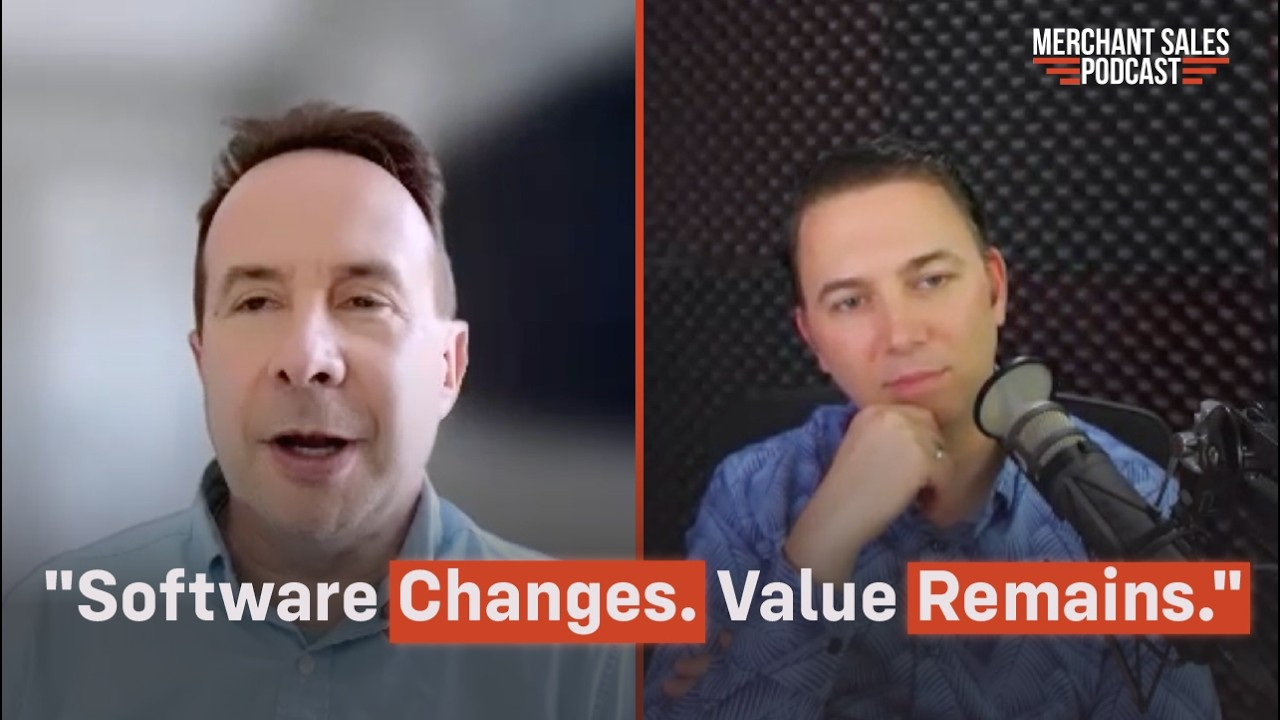
How do you build a business that is actually worth something as AI rewrites the rules of software? That question sat at the center of a recent conversation between 733Park CEO Lane Gordon and James Shepherd on the Merchant Sales Podcast. The discussion moved from the enduring value of payment portfolios to the uncomfortable new math facing software founders, and what separates a company that commands a premium from one that struggles to find a buyer.
Watch the full episode above, open it on YouTube, or read the key ideas below.
Why payment portfolios still command buyer interest
Merchant portfolios have been written off for years, yet buyers keep coming back. In 2026, a few forces are driving that demand. In an inflationary environment, residual revenue can grow on its own as the underlying merchants raise their prices, so some financial buyers treat a portfolio almost as an inflation hedge. Fintech and AI-driven acquirers see a base of merchants they can responsibly upsell into adjacent products. And larger ISOs keep buying portfolios to add inorganic revenue ahead of their own exit. The common thread is durable, recurring payments revenue, the original recurring revenue long before software made the term fashionable.
Payments revenue versus vertical SaaS: what the market rewards
One of the quieter surprises in today's market is that lenders and many buyers often value payments recurring revenue more highly than software revenue. Payment streams are tied to transaction volume and merchant behavior, which makes them harder to replicate than a feature set. As the cost of building software falls, a software-only moat gets thinner, while a durable payment relationship holds its value.
How AI is changing software valuations
Gordon uses a simple image on the show: value is like the sun in the sky, always shining on something. A decade ago it shone on legacy payments, then on ISVs, then on vertical SaaS, and now it is shining on AI. The practical takeaway for owners is that AI is collapsing the cost of building software. Platforms that cost millions to build a few years ago can be approximated for a fraction of that today, and the number keeps dropping. If your competitive advantage is that your features are better, that advantage is eroding by the month.
What still holds value: a sticky customer base with no reason to leave, a defensible niche vertical with real depth, proprietary data and relationships that AI cannot crawl its way into, and durable payments revenue rather than software fees alone.
A product is not a business
It is one of Gordon's recurring lines with founders. A beautiful piece of technology with no team and no customers is a dusty product on a shelf. It may do impressive things, but so does a general AI assistant for a couple hundred dollars a month. Buyers pay for customers, revenue, and people. In many deals the team and expertise drive the price, which is why acqui-hires, where a larger company acquires a business mainly for its people, remain common.
Sell into strength, not after the slowdown
The strongest time to sell is while growth is still accelerating. Buyers pay premium multiples for double-digit growth, and once that growth slows, multiples compress quickly. A buyer can see when 20 percent annual growth becomes 8, then 5, then 3, and prices accordingly. Owners should keep reassessing where they sit in the company life cycle, and in fast-moving categories a six to eighteen month window can be the difference between a great outcome and a good one.
Why professional representation adds value
Plenty of owners try to handle a sale themselves to save a fee, often with a buyer they already know. It can work, but it usually leaves money on the table. A competitive, professionally run process keeps buyers honest and surfaces the strategic buyer willing to pay the final marginal dollar, rather than an unsolicited offer that anchors low. That dynamic only exists in an auction, not in a one-to-one conversation between friends.
Frequently asked questions
Why are payment processing portfolios still valuable in 2026?
Merchant portfolios produce steady, recurring residual revenue. In an inflationary environment those residuals can grow as merchants raise prices, so some buyers treat a portfolio as an inflation hedge. Fintech and AI buyers see a base of merchants to upsell, and larger ISOs acquire portfolios to add inorganic revenue ahead of an exit.
Is payments revenue valued more highly than vertical SaaS revenue?
Often, yes. Lenders and many buyers view payments revenue as more durable than software revenue because it is tied to transaction volume rather than features that AI can increasingly replicate. As the cost of building software falls, software-only moats weaken while payment streams and distribution hold their value.
How is AI changing software and vertical SaaS valuations?
AI is collapsing the cost of building software, which erodes feature-based moats. The businesses that retain value have a sticky customer base, a defensible niche vertical, deep proprietary data, or a service component AI cannot easily reproduce. Generic, easily replicated tools are the most exposed.
What makes a software company command a premium valuation?
Buyers want a real business, not just code: paying customers actively transacting, a capable team, and a genuine product, ideally in a defensible vertical. A polished piece of technology with no team and no customers has little value, because comparable capability is increasingly available off the shelf.
Does using an M&A advisor actually increase the sale price?
In 733Park's experience, professional representation adds meaningful value versus negotiating directly with a familiar buyer. A competitive process keeps buyers honest and surfaces the strategic buyer willing to pay the final marginal dollar, rather than accepting an unsolicited offer that leaves value on the table.
When is the best time to sell a payments or software business?
While growth is still accelerating. Buyers pay premium multiples for double-digit growth, and once growth slows, multiples compress quickly. In fast-moving categories, a six to eighteen month window can matter.
Talk to 733Park
733Park advises owners in payments, fintech, AI, and vertical SaaS, from merchant portfolios to eight and nine figure software businesses. Whether you are ready now or planning ahead, the conversation is worth having. Reach us at info@733park.com or (617) 564-0404, or explore more on our Insights page. You can also watch the full Merchant Sales Podcast episode here.